Close

Carl Gustaf 4000

The History of Carl Gustaf

The Carl Gustaf company was founded in 1812. First known as Carl Gustafs Stads Gevärsfaktori or ‘Rifle Factory of Carl Gustaf's Town’, it was serving as a state arsenal. After the king of Sweden Karl X Gustav gave the city privileges to the town of Eskilstuna, it was thenceforth often referred to as 'Carl Gustav's town'.

In the first years of operating, the company primarily manufactured small arms for the Swedish Army, starting a long-lasting tradition of firearms making. For over two centuries Carl Gustaf has been known for many popular small arms, many of them relying on foreign design – such were for instance Mausers M94, M38, M1896 (often touted as the Swedish Mauser), the M41, and the Remington M1867 rolling block rifle. The governmental agency Försvarets Fabriksverk (FFV), the complex often referred to as FFV-Carl Gustaf, managed the factory from 1943 to 1991.

One of the biggest breakthroughs in CG weapon design happened in 1942 with the introduction of a single-shot M/42 AT anti-tank weapon for the infantry which had been used until 1944. In 1946, it was replaced by the 84 mm recoilless rifle which is still one of the most widespread anti-tank systems in use today. In the late 50s, a commercial variant of the M1986 became available under the name Carl Gustaf M63 which was in service from the late 1950s until the early to mid-1960s.

In 1970 the FFV-Carl Gustaf bought the Husquarna Group, and they took over the production of various models, such as the 1900 hunting rifle which was later upgraded to the 2000 series. The production of CG 2000 was postponed when the company purchased the rights to import the unrefined and finished rifles from Sauer. Consequently, various Sauer models were sold under the Carl Gustaf brand – Sauer 80 as Carl Gustaf 3000 and Sauer 200 as Carl Gustaf 4000. Near the turn of the century, the company started making the model 2000 once again.

From 1970 until 1985, a Swedish-made version of the G3A3 named the AK 4 was manufactured exclusively by Carl Gustaf in Eskilstuna. It was succeeded by the AK 5 assault rifle in 1986, being the primary weapon of the Swedish Army at the time.

In the 90s, the Calf Gustaf was under the parentage of Celsius Group which was bought by Saab AB in 1999. Later, the United Defense Industries took over the heavy weapons department. Nowadays the company consists of Swedish BAE Systems AB and Saab AB with British BAE Systems and Saab Bofors Dynamics being subsidiary divisions. The Saab company specializes in the production of fighter systems, submarines, and ground combat weapons. With the fourth generation of the 84mm recoilless gun – the CG A4 – they are keeping the trademark alive, staying loyal to the Carl Gustaf tradition of high-quality weaponry. 

Carl Gustaf 4000 Rifle Review

Carl Gustaf 4000 is a bolt-action rifle that can also be recognized under the ‘Sauer 200 Lang’ name. Various Sauer models were sold under the Carl Gustaf brand when the company purchased the right to import unrefined and finished rifles from Sauer. The rifle was produced between the years 1984 and 1993 by both - Sauer and Carl Gustaf.

Push feed bolt with six locking lugs is housed in a steel or aluminum alloy receiver that is known for its smoothness. The lugs lock up directly with the barrel instead of the receiver. Switching the barrel and converting it to a different caliber is made possible by the modular design.

The rifle’s safety operation consists of a vertically mounted slide which can be found within the trigger guard. There is a rubber recoil pad at the end of the stock. CG 4000 comes with a detachable box vertical stack magazine that can hold up to five cartridges.

Carl Gustaf 4000

Figure 1: Carl Gustaf 4000, chambered for the .308 Win. (Source: https://www.lauritz.com/de/auktion/jagtriffel-carl-gustaf-4000-kaliber-308-linx-sauer-200/i3368542/?param=showdesktopversion)

Carl Gustaf 4000 Calibers

Carl Gustaf 4000 can be chambered for the following calibers:

  • .243 Win.

  • .308 Win.

All CG 4000 receivers come with four holes for mounting purposes, two on the front and two on the rear mounting surface.

The receiver of Carl Gustaf 4000

Figure 2: The receiver of Carl Gustaf 4000, chambered for .308 Win. (Source: https://wf-sports.eu/epages/e88e1140-a377-4191-9c98-192a1dc989ab.mobile/de_DE/) 

The mounting surface of Carl Gustaf 4000

A: 21.9 mm

B: 100.5 mm

C: 21.9 mm

BHU: 0 mm

Ø: 6-48

R1: R17.4

R2: R17.4

Scope Mounts Interchangeable With Carl Gustaf 4000

Rifles That Have One-Piece Scope Mounts Interchangeable With Carl Gustaf 4000

All the rifles listed in the category below have one-piece mounts interchangeable with Carl Gustaf 4000. For one-piece mounts to fit on a rifle, mounting surfaces on these rifles must match in every dimension. Rifles that share the same dimensions and mounting surface as Carl Gustaf 4000 are:

Rifles That Have Two-Piece Scope Mounts Interchangeable With Carl Gustaf 4000

All the rifles listed in the category below have two-piece mounts interchangeable with Carl Gustaf 4000. To meet interchangeability conditions, two-piece mounts must match in all dimensions except the B distance. B distance can vary because two-piece mounts can be installed and adjusted closer or further apart. The rifle that meets such criteria is: 

Best Scope Mounts for Carl Gustaf 4000 

Fixed Scope Mounts for Carl Gustaf 4000

Being robust, recoil resistant and easy to install, the MAKfix rings with bases are a suitable fixed mounting solution for Carl Gustaf 4000.

Detachable Repeatable Scope Mounts for Carl Gustaf 4000

If you are in search of detachable mounts that are quick and easy to install, we recommend this two-piece repeatable pivot mount made by the German company MAK. It is made of high-quality steel and comes with a thirty-year warranty.

Picatinny Rails for Carl Gustaf 4000

When purchasing Picatinny rail one should always pay attention to the distance between the holes on the mounting surface of the rifle. We recommend this steel Picatinny rail made by the German company EAW. Although the name suggests that it is suitable for Sauer 200 Lang, the rail will also fit onto the Carl Gustaf 4000 as the two rifles come with the same receiver dimensions and thus have interchangeable one-piece scope mounts.

Help Us Build Our Riflescope Mounts Database

If you happen to own this or any other rifle, we would appreciate it if you could help us expand our database by sending us some photos of the rifle receiver (the bare mounting surface of the rifle without the scope mounts installed). For your help, our company offers a fair return in terms of practical rewards.

Please send us an email for more information. You can contact us here: info@optics-trade.eu  

Filters
Sort
37 Items
Show
per page
Close
Sort By
  1. In stock
  2. Out of stock
  1. Cheapest in stock
In stock
AU$117.79
In stock
AU$117.79
In stock
As low as AU$516.70
In stock
AU$175.88
In stock
AU$145.22
In stock
As low as AU$138.77
In stock
AU$175.88
In stock
As low as AU$108.11
In stock
As low as AU$108.11
In stock
As low as AU$145.22
In stock
AU$145.22
In stock
AU$108.11
In stock
AU$138.77
In stock
AU$154.91
In stock
AU$154.91
In stock
As low as AU$108.11
In stock
AU$104.88
In stock
AU$104.88
In stock
AU$77.45
In stock
AU$175.88
In stock
AU$158.13
In stock
AU$175.88
In stock
AU$117.79
In stock
AU$117.79
In stock
AU$117.79
In stock
As low as AU$208.16
In stock
AU$208.16
In stock
AU$104.88
In stock
AU$154.91
In stock
AU$154.91
In stock
As low as AU$124.25
In stock
AU$138.77
In stock
AU$116.18
In stock
AU$116.18
In stock
As low as AU$169.43
In stock
As low as AU$169.43
In stock
AU$169.43
Filters
Sort
37 Items
Show
per page
Close
Sort By

VIDEO

Introduction

In recent years we can observe that a trend of Picatinny rail has become widespread and global. It is driven by the NATO standardized rails, more commonly known as the Picatinny rail standard. Picatinny rail being the New Jersey Arsenal that developed it in 1995.

These mounting options are revolutionary. The biggest and best advantage being that the Picatinny rail can be used its entire length and not bordered to a few pre-designed slots like for example the Weaver rail standard was before.

The other main advantage is the ease of use and interchangeability. If a product is meant for a Picatinny rail design it will fit all Picatinny-rails, no matter the manufacturer or date of production.

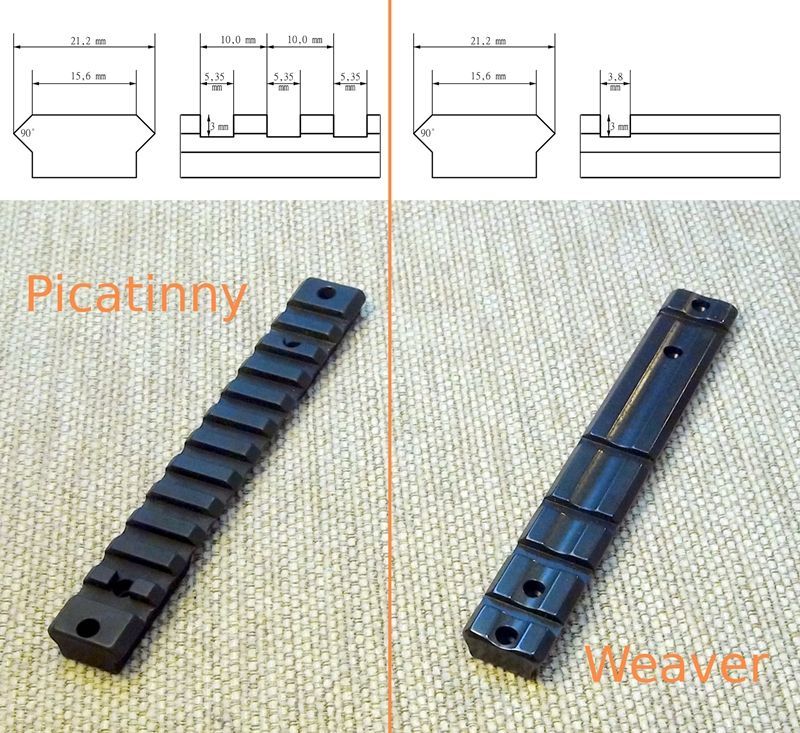
Picatinny/Weaver Rail

Picatinny Rail and Weaver rail profile

Design

The Picatinny rail is almost exclusively crafted from a single piece of metal (in some cases aluminum). In this manner, the axis of the Picatinny rail is perfectly straight and aligned with the axis of the firearm. Therefore the rifle scope which is mounted onto this kind of configuration is certainly aligned with the rifle / gun and the trajectory of the ammunition.

Weaver rail design on the other hand is usually manufactured in two separate pieces, greatly increasing the possibilities for the axis to be crooked, overlapping, and out of line.

It is always harder to align two separate pieces to a third line than it is to align one piece to another. In this way, the lapping of two mounting rings on a single-piece Picatinny rail is no longer required.

The single-piece rail will assure that both rings are perfectly aligned to each other and that no unwished stress is transferred to the riflescope.  

Picatinny compare to Weaver Rail

The Picatinny rail itself is an evolutionary step forward from the older Weaver rail. The main difference between Picatinny rail and Weaver rail is the spacing of the slots. Picatinny rail design has them evenly placed exactly 5.23 mm from one slot to the other, 3 mm deep. For this reason, the mounting options are repeatable and the same as other firearms using the Picatinny rail standard.

Interchangeability was a major driving force in the development of the new standard as different NATO armies need to be compatible with each other.

Weaver rail has 3.8mm wide slots and these slots can be placed anywhere on the Weaver rail and in any number that the producer wished.

Advantages of Picatinny design

A big advantage for using the Picatinny rail design is the ever-present recoil stop. Furthermore, the manufacturing of the rail is not very technically demanding and can be done without the use of state-of-the-art machines which greatly reduces the cost of the finished product, making it very affordable.

The Picatinny rail is easy to mount and usually, this type of configuration does not transfer negative stresses and forces from the fired weapon to the rifle scope.

In addition, the Picatinny rail with its very long useable surface works well for mounting longer rifle scopes or to achieve optimum eye relief.

The durability and toughness are other big pluses for this solution.

Manufacturers of Popular Models

A majority of the Picatinny rings are fixed, but a number of best rated European manufacturers (EAW, MAK,..) have, in recent years, put a lot of effort into the development of detachable ring with100% repeatability, with which it becomes easy to remove the scope from the weapon without the use of tools.

No re-zeroing is needed with such mount options, but these models tend to be expensive. 

Weaver and Picatinny Rings

Picatinny rail and weaver rail share one more thing. It is possible to use the Weaver ring and the Picatinny ring on the Picatinny-rails, but it is usually impossible to use the Picatinny ring on the Weaver base. The reason being the above-mentioned positioning and spacing of the slots.

  • Picatinny mounts have a 5mm recoil stop that goes into the rail slot and since
  • Weaver rail only has 3.8mm wide slots such rings do not fit on Weaver rails.

Due to this reason, the Picatinny-rails are popular and prevailing on the market in recent years and eventually, these options will completely oust the Weaver rail from the market.