Close

Mauser K98k (Bulb)

About the Mauser

Back in 1811, Friedrich I of Wurttemberg launched an arms factory in Oberndorf, Germany. Employing 133 workers, the company officially started its business in the following year serving as the royal weapon forge. The initial moderate success of the company was refined in 1867 when Wilhelm and Paul Mauser came up with an innovative rotating bolt system used for breechloading rifles. Most of their rifles at the time were built around a 7.9x57J cartridge which eventually became known as the 8mm German cartridge.

Alongside the Model 93 release, the smaller, 7x57mm cartridge was introduced. The United States spotted the potential of German ingenuity; hence they incorporated many features of Mauser design into their 1903 Springfield and so did the United Kingdom with their SMLE rifle that was the standard of British infantry units up until the 1950s. Soon after, many countries around the world, such as Turkey, Brazil, South Africa, Iran, Sweden and even China had recognised the outstanding performance of Mauser 93 and began flooding the company with new orders.

Along with their rifle production success, Mauser also broke new ground in 1896 with the introduction of their autoloading C96 pistol that was produced up until 1936. In 1897 the Mauser family were given control over the factory and renamed it Waffenfabrik Mauser AG. Only a year later, one of the most recognisable Mauser rifles of all time was presented by the company – Mauser Gewehr 98. The rifle had been redesigned with some of the noticeable changes being better-ruptured case gas venting, a stronger receiver with a larger receiver ring and an extra third locking lug providing additional safety. In later years, numerous rifles were derived from the original Gewehr 98 design, a lot of them being manufactured by various German contractors.

In the first decades of the 20th century, Mauser introduced a myriad of hunting rifles such as Type A, Model B, Model K, Armee-Model C and Africa Model. Up until the 1960s, various other models were presented including M1916, Mauser 1925 Special range, Karabiner K98, Mauser KKW cadet rifle, Gewehr 41 etc. Alongside their rifle production, the company additionally focused on the production of hand and pocket pistols, with some of the most recognizable models being Mauser 1910, Mauser 1914, Model 1934, and Mauser HSc.

After World War II, when the company was seized by Allied forces and placed under French control, the factory was torn down, and its records were destroyed. The former Mauser engineers Edmund Heckler and Theodor Koch, together with their associate Aled Seidel founded Heckler and Koch arms firm in the following years, recovering some leftovers of Mauser company which remained in the arms of Allied forces until 1952 when it was again permitted to continue manufacturing firearms. In the second half of the 20th century, the company presented some new models such as Model 66, Model 77, Model 86SR, Mauser SP66, Models 94 and 96, Mauser SR 97, Mauser 90SA and Mauser 90DA.

The Rheinmetall Berlin AG bought the firearms division of the company in 1996 and renamed it to Mauser-Werke Oberndorf Waffensysteme GmbH. In 1999, part of the Mauser was sold to Schweizerische Industrie Gesellschaft company often referred to as SIG, which later became known as Mauser Jagdwaffen GmbH.

Today, the company is under the parentage of the Blaser Group, which also manufactures rifles under the J.P. Sauer & Sohn brand. Mauser has presented some new models in the last few years, such as Mauser M03, M12, and M18, attesting to the company’s rich and successful history once again.

Mauser K98k (Bulb) Rifle Review

Mauser K98k is a controlled feed bolt-action rifle introduced in 1935 used as a primary infantry rifle of the German army during World War II. K98k was derived from some of the Mauser’s earlier rifles such as Karabiner 98b and Gewehr 98, thus it shares most of the design details with the forerunners. The main change was made in the design of a straight bolt handle which was reshaped and bent, allowing for a faster bolt operation and optics mounting directly on the top of the receiver.

The rifle went through some design changes in the course of the production period as the demand increased during the war and the manufacturers had to find new ways to fulfil the increased number of orders. The pre-war version of K98k came with an included cleaning rod, fitted through a bayonet stud which was banned on later versions. Another change was the stock wood - the early rifles came with a walnut stock whereas the newer ones used laminated wood. Some finesses such as milled steel parts or the removable front sight were replaced by a production-friendlier stamped steel and a fixed sight. The shape of the butt plate was, on the contrary, improved on the newer versions as it was redesigned into a cupped shape increasing the overall durability of the stock which was often chipped or damaged on the early models.

However, there are no changes in the receiver design between the models produced before and during the war. The bolt body features three locking lugs, two at the front and one at the rear end of the bolt that locks up safely with the action's housing. The steel parts are blued protecting the weapon from rust. Positioned at the rear top end of the receiver, there is a standard Mauser flag-type safety lever. A dedicated bolt release lever is placed on the left rear side of the receiver.

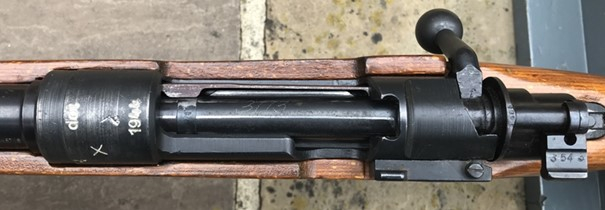
The older rifles come with a steel floorplate and an internal five-round capacity magazine that can be loaded using stripper clips, thus the receiver on those models features a bulb that functions as a guiding slot. The modern civilian version of K98k commonly known as Mauser M98 uses a receiver without a bulb, making the mounting surfaces on the rifles different; meaning that they will not fit the same scope mounts.

After the war, the allies and liberated European countries continued the production of K98k using numerous leftover parts and German machinery captured during the war. Despite using the original Mauser design, many of the newly established rifles that derived from the K98k were rebranded e.g., Yugoslavian M48, Spanish M43 or Israeli Mauser.

The possible barrel length for Mauser K98k is 600 mm (23.6-inch).

Mauser K98k chambered for 7.92x57mm Mauser

Figure 1: Mauser K98k chambered for 7.92x57mm Mauser (Source: https://www.highwoodclassicarms.co.uk/Firerms%20For%20Sale/0129.htm)

Mauser K98k can be chambered for the following calibres:

  • 7.92x57mm Mauser

  • The rifle is available in the following variants:

  • Mauser K98k Kriegsmodell

  • Mauser K98k Sniper Variant

  • Mauser K98k Paratrooper Variant

  • Mauser K98k G40k

  • Mauser K98k KKW Cadet Rifle

Mauser K98k receivers come without holes therefore they must be manually drilled by a gunsmith.

Mauser K98k chambered for 7.92x57mm Mauser

Figure 2: The receiver of Mauser K98k, chambered for 7.92x57mm Mauser (Source: https://www.highwoodclassicarms.co.uk/Firerms%20For%20Sale/0129.htm)

A: 22 mm

B: /

C: 13 mm

BHU: 4 mm

Ø: /

R1: R14/30°

R2: R18

The abovementioned data describes the receiver radius together with the height difference between the front and rear mounting surface. The distance between the front and rear surface holes (A & C) is provided based on the Rusan pivot mount that we recommend and is one of the frequently used holes positioning for this rifle.

Please note that the positioning of the holes on the rail and receiver is determined by a gunsmith before drilling and can vary.

Which Rifles Have Interchangeable Mounts

Two-piece mounts

All the rifles listed in the category below have two-piece mounts interchangeable with Mauser K98k Standard. To meet interchangeability conditions, two-piece mounts must match in all dimensions except the B distance. B distance can vary because two-piece mounts can be installed and adjusted closer or further apart. Since the K98k comes without pre-drilled holes on the receiver, the interchangeability conditions mostly depend on BHU which is the difference in height between the front and rear mounting surface and the surface radius. Rifles that meet such criteria are:

  • Gewehr 98

  • Zastava M48

  • Spanish Mauser M43

  • Israeli Mauser

One-piece mounts

All the rifles listed in the category below have one-piece mounts interchangeable with Mauser K98k. For one-piece mounts to fit on a rifle, mounting surfaces on these rifles must match in every dimension. Rifles that share the same dimensions and mounting surface with Mauser K98k are:

  • Gewehr 98

  • Zastava M48

  • Spanish Mauser M43

  • Israeli Mauser

*As the K98k comes without holes on the receiver, the interchangeability conditions depend on the overall length and shape of the receiver. Please note that the old versions of Mauser K98k come with a bulb on the receiver which is used for stripper-clip feeding.

The modern civilian version of K98k commonly known as Mauser M98 uses a receiver without a bulb, making the mounting surfaces on the rifles different; meaning that they will not fit the same scope mounts.

Our Recommendations for Mounts 

Detachable Repeatable Mounts

Detachable pivot mounts make attaching and detaching your preferred optic an easy task. This pivot mount made by the Croatian company Rusan is repeatable and comes with a ten-year warranty, making it a suitable choice for Mauser K98k.

Picatinny Rails

This Picatinny rail manufactured by the German company EAW is made of steel and will be a suitable fit for Mauser K98k.

The rail comes without holes therefore they must be manually drilled by a gunsmith.

Help Us Build Our Riflescope Mounts Database

If you happen to own this or any other rifle, we would appreciate it if you could help us expand our database by sending us some photos of the rifle receiver (the bare mounting surface of the rifle without the mounts installed). For your help, our company offers a fair return in terms of practical rewards.

Please send us an email for more information. You can contact us here: info@optics-trade.eu  

Filters
Sort
8 Items
Show
per page
Close
Sort By
  1. In stock
  2. Out of stock
  1. Cheapest in stock
In stock
AU$117.79
In stock
AU$117.79
In stock
AU$145.22
In stock
AU$676.10
In stock
AU$117.79
In stock
AU$117.79
In stock
AU$104.88
In stock
AU$145.22
Filters
Sort
8 Items
Show
per page
Close
Sort By

VIDEO

Introduction

In recent years we can observe that a trend of Picatinny rail has become widespread and global. It is driven by the NATO standardized rails, more commonly known as the Picatinny rail standard. Picatinny rail being the New Jersey Arsenal that developed it in 1995.

These mounting options are revolutionary. The biggest and best advantage being that the Picatinny rail can be used its entire length and not bordered to a few pre-designed slots like for example the Weaver rail standard was before.

The other main advantage is the ease of use and interchangeability. If a product is meant for a Picatinny rail design it will fit all Picatinny-rails, no matter the manufacturer or date of production.

Picatinny/Weaver Rail

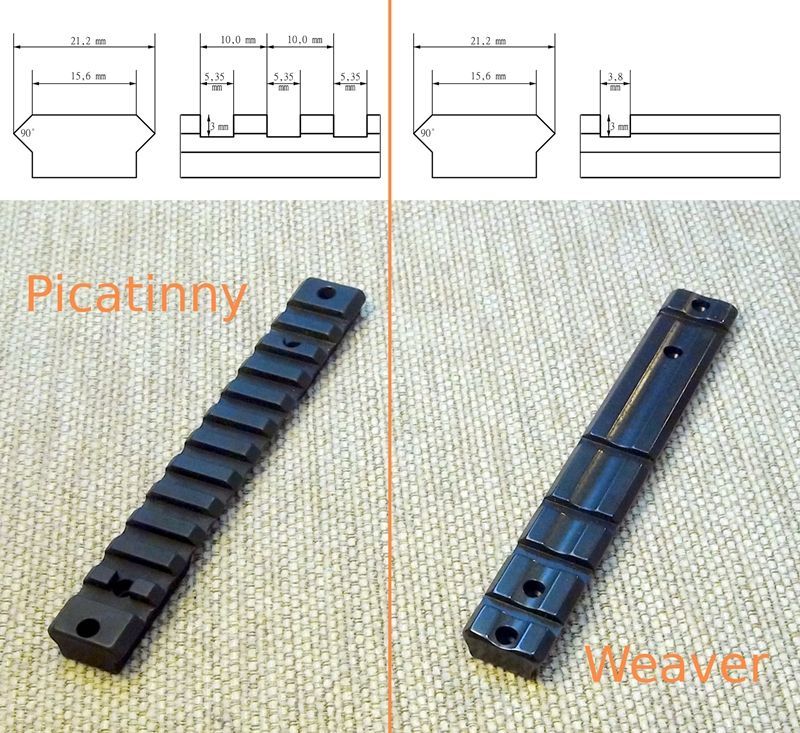
Picatinny Rail and Weaver rail profile

Design

The Picatinny rail is almost exclusively crafted from a single piece of metal (in some cases aluminum). In this manner, the axis of the Picatinny rail is perfectly straight and aligned with the axis of the firearm. Therefore the rifle scope which is mounted onto this kind of configuration is certainly aligned with the rifle / gun and the trajectory of the ammunition.

Weaver rail design on the other hand is usually manufactured in two separate pieces, greatly increasing the possibilities for the axis to be crooked, overlapping, and out of line.

It is always harder to align two separate pieces to a third line than it is to align one piece to another. In this way, the lapping of two mounting rings on a single-piece Picatinny rail is no longer required.

The single-piece rail will assure that both rings are perfectly aligned to each other and that no unwished stress is transferred to the riflescope.  

Picatinny compare to Weaver Rail

The Picatinny rail itself is an evolutionary step forward from the older Weaver rail. The main difference between Picatinny rail and Weaver rail is the spacing of the slots. Picatinny rail design has them evenly placed exactly 5.23 mm from one slot to the other, 3 mm deep. For this reason, the mounting options are repeatable and the same as other firearms using the Picatinny rail standard.

Interchangeability was a major driving force in the development of the new standard as different NATO armies need to be compatible with each other.

Weaver rail has 3.8mm wide slots and these slots can be placed anywhere on the Weaver rail and in any number that the producer wished.

Advantages of Picatinny design

A big advantage for using the Picatinny rail design is the ever-present recoil stop. Furthermore, the manufacturing of the rail is not very technically demanding and can be done without the use of state-of-the-art machines which greatly reduces the cost of the finished product, making it very affordable.

The Picatinny rail is easy to mount and usually, this type of configuration does not transfer negative stresses and forces from the fired weapon to the rifle scope.

In addition, the Picatinny rail with its very long useable surface works well for mounting longer rifle scopes or to achieve optimum eye relief.

The durability and toughness are other big pluses for this solution.

Manufacturers of Popular Models

A majority of the Picatinny rings are fixed, but a number of best rated European manufacturers (EAW, MAK,..) have, in recent years, put a lot of effort into the development of detachable ring with100% repeatability, with which it becomes easy to remove the scope from the weapon without the use of tools.

No re-zeroing is needed with such mount options, but these models tend to be expensive. 

Weaver and Picatinny Rings

Picatinny rail and weaver rail share one more thing. It is possible to use the Weaver ring and the Picatinny ring on the Picatinny-rails, but it is usually impossible to use the Picatinny ring on the Weaver base. The reason being the above-mentioned positioning and spacing of the slots.

  • Picatinny mounts have a 5mm recoil stop that goes into the rail slot and since
  • Weaver rail only has 3.8mm wide slots such rings do not fit on Weaver rails.

Due to this reason, the Picatinny-rails are popular and prevailing on the market in recent years and eventually, these options will completely oust the Weaver rail from the market.