Close

Riflescopes with Variable magnification

Introduction

People enjoy going outdoor and observing life outside of four walls. You do not need any particular skill to get in touch with the nature that surrounds you. However, for you to properly observe the subtle happenings you would otherwise miss and to successfully hit a target when hunting, experience, as well as proper gear, is definitely needed.

That is where variable magnification rifle scopes can come in handy, particularly when hunting in a smaller area, as they let the user adjust the magnification so as to focus on the target when moving closer or farther away from it. These rifle scopes can be recognized by the range in their specification, not a particular number. This setting is endless, signifying that the magnification of the rifle scope is not locked.

Swarovski Z6i gen.2 2-12x50 BT SR

History

In the beginning, only rifle scopes with fixed magnification were manufactured but as time has moved forward, rifle scopes with variable magnification were produced. As a matter of fact, Kahles was among the first manufacturer to introduce variable magnification rifle scopes and later, all major manufacturers followed in its footsteps.

Now the tables have turned, fixed scopes have fallen out of flavor, and at the moment, only a few manufacturers still produce fixed magnifications rifle scopes and later on, you will be able to see why. We would not call ourselves psychic, but we can certainly predict what the future holds in this scenario and that is that variable magnification scopes will prevail. Let us see why:

Pros

The use of these scopes is extremely versatile. When observing on shorter ranges, the magnification should be turned down, and up when observing on longer ranges. Also, these rifle scopes tend to have a wider field of view, which provides less restriction when observing, which is always an advantage.

Even experienced hunters can get sidetracked and lose focus, but with variable magnification rifle scopes, you get complete and utter control of the device. If the target moves closer, you can just adjust the magnification and regain the focus, so there is no need to worry.

These rifle scopes offer you multiple options – hence the name. On the one hand, at high magnification, you are able to observe the animals as you please and observe the fine details on the target. On the other hand, at lower magnification, you are able to take a shot even if the rifle scope is rested on a shooting stick, or even without support.

Cons

In spite of its many excellent features, the variable magnification rifle scope still has a few drawbacks. The first one is that these scopes do not produce the same light transmission rate as the fixed ones. Because adjustments cannot be made on the latter, they feature only one glass, in comparison to variable magnification scopes, which have numerous glasses in front of the lens, resulting in a lower light transmission rate.

These optics are also bigger in size, as well as weight, and they also sport a bigger tube diameter, usually at least 30 mm. That is why you should always make sure you choose the rifle scope you are comfortable using. Also, you need to set one more setting before the shot, which can prove to be troublesome. There may also be times where the cheaper second focal plane scopes have the option of a movable point of interest when magnification is changed.

Kahles K1050 10-50x56

Zoom Factor

Variable magnification rifle scopes have come a long way, as the zoom ratio they started off with was 2 x and 3 x, now there are scopes with a 10 x zoom ratio. It used to be a standard to have a 3 x zoom in 1-inch tube scopes and a 4 x zoom in 30 mm tube rifle scopes.

More and more manufacturers like Swarovski and IOR began producing rifle scopes with a much wider zoom ratio. Soon after, others, such as Zeiss, Leica, Schmidt & Bender followed. Today, even a 10 x zoom factor is not uncommon, thus the versatility of the rifle scopes is greatly enhanced.

Conclusion

Variable magnification rifle scopes are of great help when wanting to dodge the ongoing debate about which magnification should be used for your hunt, as they provide a lot of diversity in said magnification. It can be adjusted based on where you are at, and what you are after.

These scopes are great for hunting in smaller areas, and for those who love a good challenge of chasing. Even though these scopes may be a bit pricier, they make up for it, as they can be used anywhere. But remember: at the end of the day, pick the scope that meets your level of experience and the intended use.

Filters
Sort
Items 1-100 of 140
Show
per page
Close
Sort By
  1. In stock
  2. Out of stock
  1. Cheapest in stock
3D model
In stock
CHF 1,379.41
In stock
As low as CHF 1,655.47
In stock
As low as CHF 919.30
3D model
In stock
Ask for price
In stock
Ask for price
3D model
In stock
As low as CHF 462.01
In stock
CHF 1,324.19
In stock
As low as CHF 173.92 Regular Price CHF 207.05
3D model
In stock
Ask for price
In stock
As low as CHF 2,520.47 Regular Price CHF 2,796.54
3D model
In stock
As low as CHF 569.61 Regular Price CHF 670.84
3D model
In stock
As low as CHF 1,581.85
In stock
Ask for price
In stock
Ask for price
In stock
As low as CHF 744.46
In stock
Ask for price
3D model
In stock
As low as CHF 643.23 Regular Price CHF 753.66
In stock
Ask for price
In stock
Ask for price
3D model
In stock
As low as CHF 1,572.65
3D model
In stock
Ask for price
In stock
As low as CHF 302.75
In stock
Ask for price
3D model
In stock
As low as CHF 1,489.83
3D model
In stock
As low as CHF 610.15
3D model
In stock
As low as CHF 588.02 Regular Price CHF 643.23
In stock
Ask for price
3D model
In stock
Ask for price
In stock
Ask for price
3D model
In stock
Ask for price
In stock
Ask for price
In stock
As low as CHF 2,870.16 Regular Price CHF 3,578.72
3D model
In stock
As low as CHF 818.07 Regular Price CHF 910.09
In stock
As low as CHF 1,057.33
In stock
As low as CHF 1,434.62
In stock
Ask for price
3D model
In stock
As low as CHF 1,554.25
In stock
CHF 1,324.19
In stock
Ask for price
In stock
As low as CHF 321.16 Regular Price CHF 348.76
In stock
As low as CHF 1,020.52
In stock
As low as CHF 376.37
3D model
In stock
Ask for price
3D model
In stock
As low as CHF 2,878.55 Regular Price CHF 3,193.35
In stock
Ask for price
In stock
Ask for price
3D model
In stock
As low as CHF 1,591.06 Regular Price CHF 1,977.55
In stock
Ask for price
3D model
In stock
Ask for price
In stock
Ask for price
In stock
As low as CHF 569.61
In stock
As low as CHF 385.57
In stock
As low as CHF 293.55
In stock
Ask for price
In stock
Ask for price
In stock
As low as CHF 735.25
In stock
As low as CHF 1,775.10
In stock
Ask for price
In stock
As low as CHF 615.63 Regular Price CHF 753.66
In stock
As low as CHF 357.96
In stock
CHF 1,250.57 CHF 1,379.41
In stock
As low as CHF 459.19
In stock
Ask for price
In stock
As low as CHF 753.66
In stock
As low as CHF 179.44
3D model
In stock
As low as CHF 588.02 Regular Price CHF 643.23
In stock
As low as CHF 1,508.24
In stock
As low as CHF 1,241.37
In stock
As low as CHF 891.69
In stock
As low as CHF 256.74
In stock
As low as CHF 983.71
In stock
Ask for price
In stock
Ask for price
In stock
Ask for price
In stock
Ask for price
In stock
As low as CHF 1,802.71
In stock
As low as CHF 422.38
In stock
As low as CHF 624.83
In stock
As low as CHF 3,321.06
3D model
In stock
As low as CHF 321.16
In stock
As low as CHF 1,655.47
In stock
As low as CHF 173.92 Regular Price CHF 207.05
In stock
As low as CHF 210.73 Regular Price CHF 247.54
In stock
As low as CHF 247.54
3D model
In stock
As low as CHF 514.40
In stock
As low as CHF 394.77 Regular Price CHF 477.59
3D model
In stock
As low as CHF 2,005.15
3D model
In stock
As low as CHF 1,756.69
In stock
As low as CHF 413.18 Regular Price CHF 505.20
In stock
As low as CHF 827.28
3D model
In stock
As low as CHF 321.16
3D model
In stock
As low as CHF 928.50
3D model
In stock
As low as CHF 680.04
3D model
In stock
Ask for price
In stock
As low as CHF 753.66
In stock
As low as CHF 1,857.92
In stock
As low as CHF 2,041.96
In stock
As low as CHF 1,425.42
In stock
Ask for price
In stock
As low as CHF 588.02 Regular Price CHF 652.43
Filters
Sort
Items 1-100 of 140
Show
per page
Close
Sort By

VIDEO

What is considered a long distance shooting?

Today, shooting at a distance beyond 800 m is considered long range shooting. 20 years ago, hitting a target 1000 m away was deemed an achievement but this is no longer the case – much has changed. In the present, shooting at a target 2000 m away or farther is almost a norm in competitive shooting, and competitions like King of 2 Miles are expeditiously gaining in popularity. Over years, the shooting equipment has received many upgrades. Today, you can achieve a consistent accuracy with a long range rifle scope chambered in .338 LM or similar at a distance of 2 km, which is incredible.
Schmidt & Bender 3–12x50 PM II scope was one of the first riflescopes designed for this purpose. Soon, other manufacturers followed, introducing their own versions. Gradually, features such as an adjustable parallax and turn indicator were added. A modern long-range tactical rifle scope is packed with features that allow the user to shoot at a considerable distance.

Today, there are more than 10 renowned manufacturers of long-range tactical riflescopes.

King of 2 Miles (France) - long distance shooting

The King of 2 Miles competition (France) - Long distance shooting

General features of long range tactical scopes

Long range scope boasts either a MIL/MIL or MOA/MOA configuration, even though many professional shooters prefer the MIL/MIL variant because it is much easier/natural to calculate the number of clicks. MOA/MOA is usually preferred by American shooters. A long-range scope is equipped with an FFP reticle and a tube that measures at least 34 mm in diameter (34 mm, 36 mm, and 40 mm are the most common). The tube is bigger because a larger elevation range than usual is needed for long-range shooting. The maximum magnification is at least 16x, often beyond 20x. The most common value for the lens diameter is 50 mm, but it isn't rare for manufacturers to offer even bigger lens diameters on their long range scope. The turrets are of the tactical type, uncapped and robust. Most elevation turrets found on these tactical riflescopes are multi-turn. On some premium long range rifle scopes, a double-turn elevation turret is used. Zero Stop is a common feature.
A tactical turret on a Zero Compromise Optic 5-27x56 rifle scope

A tactical turret on a Zero Compromise Optic 5-27x56 rifle scope for long range shooting

Overall features of tactical turrets on a scope

As MIL/MIL tends to be the most popular configuration, these turrets often feature 0.1 MRAD clicks. Zero Stop and the locking function are common characteristics. A single-turn configuration does not grant the user a big enough elevation range, so double-turn and multi-turn turrets are much more common. Travel per rotation is also an important piece of information – 10 clicks in a single turn, for example, make it much easier to quickly dial in the number of clicks needed to land the shot. There are various turn indicators on the market. Here, we list some of the most common:

• A nonmechanical turn indicator in the form of lines underneath the turret – this option is the most common but the most annoying to use since it is difficult to tell in which turn you are (the lines are usually quite close together);
• A mechanical, intangible turn indicator – in some turrets, a color or a number change signifies the transition into another turn. Such indicators can be found on certain S & B scopes and Minox rifle scopes.
• A mechanical, tangible turn indicator – typically, a pin indicates the turn the turret is in; we can either look at it or feel it to find out in which turn we are. It can be found on some S & B scopes, Kahles scopes, and Vortex rifle scopes.

Some Schmidt & Bender and Premier Reticle riflescopes feature a unique feature called MTC (More Tactile Clicks) – each 10th click is more tactile, giving the user an option to dial in the needed number of clicks without having to look at the turret.

Tactical reticle for long range shooting

A tactical reticle is always in the first focal plane (FFP) – the reticle subtensions do not change with magnification, which means that such a reticle can be used for distance estimation and bullet drop correction at any magnification setting. In the past, the Mil-Dot reticle was commonly used but is now obsolete. Long-range tactical shooters tend to go for reticle in the shape of a Christmas tree. 'Horus' was one of the first reticles of this kind. Even though reticle illumination is not a must-have, it is most certainly a nice addition. The reticle is matched with the turret clicks, making the rifle scope either an MOA/MOA or MIL/MIL version. One of the modern trends is to have the windage turret capped – many modern riflescopes are designed in this manner. It is especially important that a click of the turret moves the point of impact exactly as listed, at precise intervals. In other words, the rifle scope must track well. Great tracking is one of the key features of an accurate rifle scope. Manufacturing a tactical rifle scope with a good tracking mechanism is not simple, which is why tactical rifle scopes with such a system generally carry a high price tag.

Horus H591 (Burris Optics)

Horus H591 (Burris Optics)

Tube diameter of a scope and mounting of long-range tactical riflescopes

A big elevation range is needed to make a successful long-range shot because of the bullet drop. The bigger the tube, the more elevation range can be implemented into a tactical rifle scope for long-distance shooting – that's a general rule. For this reason, tube diameter of 34 mm is the industry standard in this category. There are some exceptions, though:

• 35 mm – Leupold rifle scope, Vortex rifle scope, IOR rifle scope;
• 36 mm – Hensoldt rifle scopes, ZCO riflescopes;
• 40 mm – IOR rifle scopes, Sightron riflescopes.

For mounting, a high-quality aluminum monoblock mount is the most popular option. Most often, it is mounted on a Picatinny rail. Having an inclined mount (20–40 MOA) can greatly aid in long-range shooting. Spuhr, ERA-TAC, and Tier-One are the most renowned mount manufacturers in this category.

Importance of optical quality in long range scopes

Magnification on long range scope

We cannot shoot at a target far away without proper magnification. If magnification is higher than 20x, the optical quality plays a major role. Only a quality image will provide the user with enough details to take the shot. The field of view also plays a major role. Even though this type of shooting mostly takes place during the daytime, it can be prolonged into the evening, which is why the rifle scope's low light performance should not be overlooked.

Kahles Scope K624i 6-24x56

Kahles K624i 6-24x56 Long range Riflescope for tactical shooting

Extended range riflescopes

A few years ago, March launched a Genesis tactical rifle scope with a huge amount of elevation. Even though it is an excellent long-range tactical shooting rifle scope with some of the above-mentioned characteristics, Genesis is not a typical tactical rifle scope.
For extreme long-range shooting, many users combine their tactical rifle scopes with equipment such as Charlie Tarac or Nightforce Wedge Prism.

Nightforce Rifle Scope Wedge Prism

Nightforce Rifle Scope Wedge Prism - long range scope

Best long range rifle scopes

More and more long range scopes of this type are emerging on the market with every passing year. The best among them are produced by manufacturers (or individuals) with many years of expertise in this field:

• Hensoldt scopes
• Zero Compromise Optic scopes
• Leupold scopes
• Schmidt & Bender scopes
• Kahles scopes
• Steiner scopes
• Nightforce scopes
• Vortex scopes
• US Optics scopes

Most best high-quality long-range tactical rifle scopes are produced in the US, Europe, and Japan. 

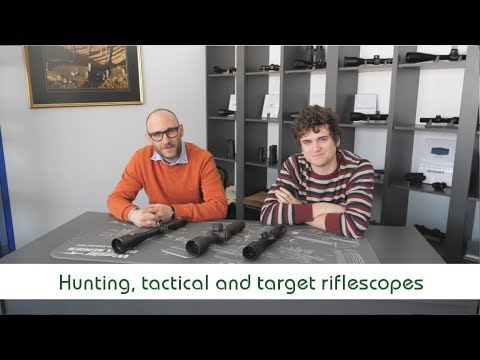
A short presentation of long distance scopes is available here