Close

Savage A17

The History of Savage Arms

Savage Arms was founded in 1894 by Arthur Savage in Utica, New York. Arthur Savage held two important patents at the time: a patent for a repeating rifle with a single-column magazine lever-action rifle, which he acquired in 1891, and a patent for a hammerless lever-action design. That paved the way for Savage’s quick rise to success.

The company’s first breakthrough came in 1895 when it introduced Model 1895 – the first hammerless lever-action rifle on the market. It was modeled after Model 1892, an earlier design that never saw production due to losing a bid for a US Army contract. Model 1895, however, won the contract for New York National Guard, but it was soon canceled due to getting caught in a contemporary political climate.

Savage continued investing efforts into the production of military-grade weapons. It was named one of the two finalists in the US Army trials for a .45 caliber semi-automatic pistol, and it lost only to the now-famous Colt M1911. Savage used the gained experience to produce high-quality pocket pistols, though, which resulted in the introduction of Model 1907, 1915, and 1917.

During World War I, Savage was merged with the Driggs-Seabury Ordnance company. The joint company focused all its efforts on the production of Lewis machine guns and heavy equipment for war purposes. 

Between the two wars, Savage decided to expand its business inside the USA. In 1920 it bought Stevens Arms of Chicopee, followed by A.H. Fox Gun Co. of Philadelphia and Davis-Warner Arms and CrescentArms Co. of Norwich in 1930. Success followed and in 1939 Savage introduced the Model 24 combination gun which sold over a million copies.

When World War II commenced, though, Savage was once again ready to answer the call of duty. It focused all its resources on war efforts, producing a staggering number of weapons. It already signed a contract with Auto Ordinance Co. in 1938 to manufacture the famous .45 caliber Thompson submachine gun, and most of these submachine guns that were used in WWII were produced by none other than Savage. The company was also contracted by the US government in 1940 to produce .30 and .50 caliber Browning machine guns. On top of that, Savage manufactured one of the most mass-produced bolt-action rifles of WWII, the British No. 4 Lee–Enfield. A record of 1.2 million Lee-Enfield rifles was produced by Savage during the time of war.

Production dialed down after the war, though. In 1946, Savage closed its facilities in Utica and moved all its operations to the Stevens manufacturing premises. Even though the Model 110 was introduced in 1958, which remains one of the company’s most successful rifles to this date, Savage started to experience some issues. In 1960 all production was moved to the current location of Westfield, Massachusetts, and what followed was a series of different ownerships over the company. Savage gradually ran into serious financial problems and in 1988 the company declared bankruptcy.

The company had to cut back on its manufacturing costs to the point where it even stopped producing short-action configurations of its most successful model, the aforementioned Model 110. It wasn’t until 1995 when Savage returned to private ownership led by Ronald Coburn who sort of rejuvenated the whole company.

In 2002 Savage introduced and patented AccuTrigger – a safe and user-adjustable trigger that soon became a success. The following year, in 2003, the company was named Manufacturer of the Year by the Shooting Industry Academy of Excellence, further reaffirming Savage’s distinction. Four years later, on May 15, 2007, Savage 93R17 BTVS has been named the best rifle in the Best of the Best presentation by Shooting Times, Sporting Gun, and Shooting Gazette magazines.

In 2013 Savage once again changed ownership. It was acquired by Orbital ATK for 315 million dollars, and it was later handed over to Vista Outdoor which later sold it for $170 million in 2019 to a group of private investors led by Savage’s management.

The company also had its logo changed in the middle of the 2010s when it decided to retire its old logo that presumably featured Chief Lame Deer, a native-American tribesman leader. The latter supposedly approached Arthur Savage in 1919 to purchase rifles for his tribe. In exchange for a discount, Lame Deer agreed to a deal. According to the deal, Savage was allowed to use Lame Deer’s face for promotional purposes. Many doubt the authenticity of this story, however, and Savage itself removed it from its official website as well.

Savage A17 Rifle Review

Savage A17 is in many aspects a revolutionary model. It was the first semi-automatic rimfire rifle specifically designed for the 17 HMR cartridge. This was possible due to the delayed blowback mechanism that Savage Arms engineers spent years on, and the results speak for themselves. Today, Savage A17 is known as an excellent choice for small game hunting. It combines semi-automatic speed with the famous Savage accuracy and precision.

Savage A17 is drilled and tapped for scope mounts, but it usually comes with either a 2-piece Weaver base or a 2-piece Picatinny base already preinstalled. This page, however, is dedicated to those A17 models that come without any bases.

Savage A17 in .17 HM2

Figure 1: Savage A17 in .17 HM2 (source: https://www.gunsandammo.com/editorial/savage-a17-hm2-review/380434)

Savage A17 features a synthetic sporter-type stock that significantly cuts on the rifle’s overall weight, which totals up to around 2.55 kg (5.63 lbs.) without a scope. The buttstock is straight, and it comes with a rubber, rather comfortably designed recoil pad.

The button-rifled barrel comes without iron sights and is 559 mm long (22-inch). It is made of carbon steel, and it offers a remarkable level of high-performance precision, especially considering the relatively low cost of the rifle. A lot of accuracy for a relatively low sum of money should basically become Savage’s official motto at this point since it’s been its mantra from the earliest days of Savage rifles.

It comes as no surprise that A17, a rifle Savage spent so much time developing, also features one of the main features the company has to offer. That is, of course, the patented AccuTriggerTM.  The AccuTriggerTM allows the user to easily adjust the trigger’s weight of the pull while still ensuring the complete safety of the rifle. A17 thus offers a crisp, user-adjustable light pull of the best possible accuracy.

The design of Savage's patented AccuTrigger

Figure 2: The design of Savage's patented AccuTrigger (source: https://pbs.twimg.com/media/BwSpbbhIIAE0hUO.jpg:large)

The trigger guard features a cross bolt safety. The red line on the side of the button indicates the rifle is in firing mode.

A17 owes its existence to the unique delayed-blowback action with a custom locking mechanism that keeps the bolt shut long enough to time the loading of the next cartridge just right. This system provides a safe and reliable operation with just about any 17 HMR load.

The action hosts a hard-chromed bolt with an oversized bolt handle. The case-hardened receiver of the rifle is also made of carbon steel and comes with a high-luster finish.

Savage A17’s magazine is rotary and has a capacity for up to 10 rounds. It is detached by pressing a lever which is found in front of the magazine.

Savage A17 Calibers

Savage A17 model can be chambered for:

  • 17 HMR

  • 17 HM2

  • 17 WSM

Savage A17 Variants

Savage A17 is currently available in six additional variants:

  • Savage A17 HM2

  • Savage A17 Target Sporter Laminate

  • Savage A17 Target Thumhole

  • Savage A17 Pro Varmint

  • Savage A17 Heavy Barrel

  • Savage A17 Sporter

If you happen to know of any other variant that we forgot to include, please let us know at info@optics-trade.eu. We will gladly update our database.

The receiver of Savage A17 is drilled and tapped for scope mounts, but those usually come pre-installed. To our knowledge, A17 normally comes with Weaver bases. Unfortunately, we couldn’t find a better image of the bare A17 receiver. If you happen to own one, we will gladly replace the bottom image with a new one. Please write us at info@optics-trade.eu.

The receiver of Savage A17 with a visible mounting surface without the pre-installed bases drilled and tapped

Figure 3: The receiver of Savage A17 with a visible mounting surface without the pre-installed bases (source: Savage Arms)

dimensions of Savage receiver

A: 21.87 mm
B: 80.87 mm
C: 21.87 mm
BHU: 0 mm
Φ: #6-48
R1: 17
R2: 17

Scope Mounts Interchangeable with Savage A17

Rifles That Have One-Piece Scope Mounts Interchangeable with Savage A17

The necessary condition for rifles to have one-piece scope mounts interchangeable is that the mounting surfaces of these rifles match in every dimension. Rifles that have one-piece scope mounts interchangeable with Savage A17 are the following:

Rifles That Have Two-Piece Scope Mounts Interchangeable with Savage A17

For two-piece scope mounts to be interchangeable, the mounting surfaces of the rifles must match in every dimension except the action length which can vary. This is because the distance between the two pieces of the mount is not fixed. Rifles that have two-piece mounts interchangeable with Savage A17 are the following:

* Sauer 200 Lang and Kurz have marginally larger front and back radii (17.4 compared to 17). This really shouldn’t impact the interchangeability, but we thought you should know nonetheless.

Best Scope Mounts for Savage A17

Fixed Scope Mounts for Savage A17

Considering all the factors, with the price of the rifle included, we think these 30 mm Talley rings would be a perfect fit for your Savage A17. They offer a great price-performance ratio, are made in the USA, and come with a 10-year warranty. They are our top recommendation for a fixed scope mount for Savage A17.

Detachable Repeatable Scope Mounts for Savage A17

This Henneberger one-piece mount earned our top recommendation for a detachable repeatable scope mount for savage A17. It is reliable and extremely versatile and is thus a great choice for your rifle. It is manufactured in Germany, is made of aluminum, and has a 30-year warranty attached to it.

It will, however, need to be coupled with a Picatinny rail. We recommend EGW’s Picatinny rail for Savage A17.

Picatinny Rails for Savage A17

When you’re looking for a Picatinny rail for your rifle, you need to pay special attention to the length between the rear and front holes on the receiver (distance B on the image above). You can hardly ever go wrong with EGW when it comes to Picatinny rails, so we recommend this EGW Picatinny rail for your Savage A17.

Help Us Build Our Riflescope Mounts Database

If you happen to own this or any other rifle, we would appreciate it if you could help us expand our database by sending us some photos of the rifle receiver (the bare mounting surface of the rifle without the mounts installed). For your help, our company offers a fair return in terms of practical rewards.

Please send us an email for more information. You can contact us here: info@optics-trade.eu

Filters
Sort
8 Items
Show
per page
Close
Sort By
  1. In stock
  2. Out of stock
  1. Cheapest in stock
In stock
€98.00
In stock
As low as €319.00
In stock
As low as €67.00
In stock
€67.00
In stock
As low as €67.00
In stock
€67.00
In stock
As low as €67.00
In stock
€98.00
Filters
Sort
8 Items
Show
per page
Close
Sort By

VIDEO

Introduction

In recent years we can observe that a trend of Picatinny rail has become widespread and global. It is driven by the NATO standardized rails, more commonly known as the Picatinny rail standard. Picatinny rail being the New Jersey Arsenal that developed it in 1995.

These mounting options are revolutionary. The biggest and best advantage being that the Picatinny rail can be used its entire length and not bordered to a few pre-designed slots like for example the Weaver rail standard was before.

The other main advantage is the ease of use and interchangeability. If a product is meant for a Picatinny rail design it will fit all Picatinny-rails, no matter the manufacturer or date of production.

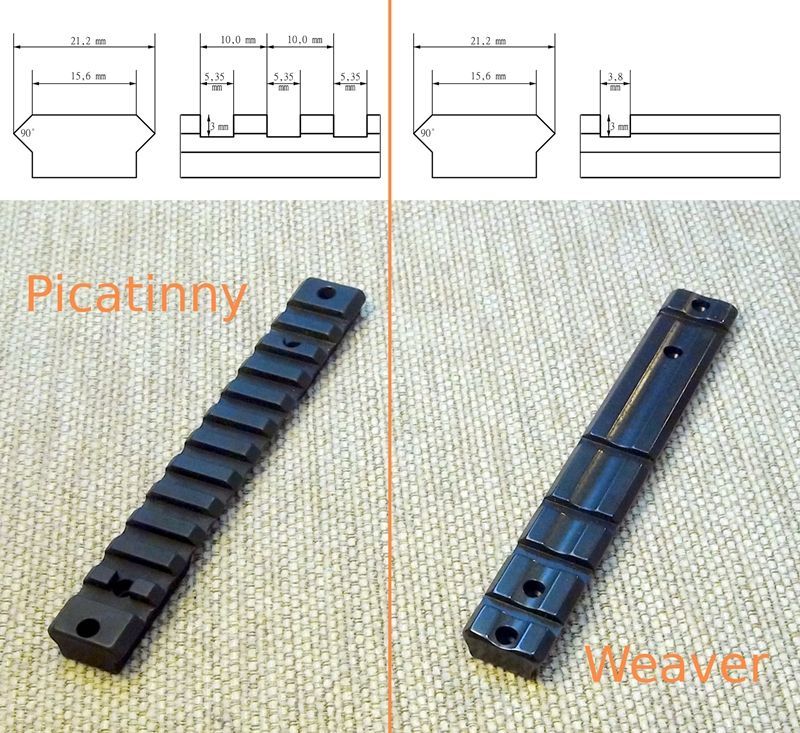
Picatinny/Weaver Rail

Picatinny Rail and Weaver rail profile

Design

The Picatinny rail is almost exclusively crafted from a single piece of metal (in some cases aluminum). In this manner, the axis of the Picatinny rail is perfectly straight and aligned with the axis of the firearm. Therefore the rifle scope which is mounted onto this kind of configuration is certainly aligned with the rifle / gun and the trajectory of the ammunition.

Weaver rail design on the other hand is usually manufactured in two separate pieces, greatly increasing the possibilities for the axis to be crooked, overlapping, and out of line.

It is always harder to align two separate pieces to a third line than it is to align one piece to another. In this way, the lapping of two mounting rings on a single-piece Picatinny rail is no longer required.

The single-piece rail will assure that both rings are perfectly aligned to each other and that no unwished stress is transferred to the riflescope.  

Picatinny compare to Weaver Rail

The Picatinny rail itself is an evolutionary step forward from the older Weaver rail. The main difference between Picatinny rail and Weaver rail is the spacing of the slots. Picatinny rail design has them evenly placed exactly 5.23 mm from one slot to the other, 3 mm deep. For this reason, the mounting options are repeatable and the same as other firearms using the Picatinny rail standard.

Interchangeability was a major driving force in the development of the new standard as different NATO armies need to be compatible with each other.

Weaver rail has 3.8mm wide slots and these slots can be placed anywhere on the Weaver rail and in any number that the producer wished.

Advantages of Picatinny design

A big advantage for using the Picatinny rail design is the ever-present recoil stop. Furthermore, the manufacturing of the rail is not very technically demanding and can be done without the use of state-of-the-art machines which greatly reduces the cost of the finished product, making it very affordable.

The Picatinny rail is easy to mount and usually, this type of configuration does not transfer negative stresses and forces from the fired weapon to the rifle scope.

In addition, the Picatinny rail with its very long useable surface works well for mounting longer rifle scopes or to achieve optimum eye relief.

The durability and toughness are other big pluses for this solution.

Manufacturers of Popular Models

A majority of the Picatinny rings are fixed, but a number of best rated European manufacturers (EAW, MAK,..) have, in recent years, put a lot of effort into the development of detachable ring with100% repeatability, with which it becomes easy to remove the scope from the weapon without the use of tools.

No re-zeroing is needed with such mount options, but these models tend to be expensive. 

Weaver and Picatinny Rings

Picatinny rail and weaver rail share one more thing. It is possible to use the Weaver ring and the Picatinny ring on the Picatinny-rails, but it is usually impossible to use the Picatinny ring on the Weaver base. The reason being the above-mentioned positioning and spacing of the slots.

  • Picatinny mounts have a 5mm recoil stop that goes into the rail slot and since
  • Weaver rail only has 3.8mm wide slots such rings do not fit on Weaver rails.

Due to this reason, the Picatinny-rails are popular and prevailing on the market in recent years and eventually, these options will completely oust the Weaver rail from the market.