Close

Sabatti Rover 870

The History of Sabatti

Sabatti’s history can be traced back to the early 18th century’s Val Trompia, a region in northern Italy that is historically well known for metalworking and arms manufacturing. We know of one Lodovico Sabatti working there as a gunsmith in the early 1700s, in the city of Gardone Val Trompia. He was regarded as an excellent barrel maker and a flintlock pistol maker, skills that later became somewhat of a trademark for the Sabatti family.

In the first half 1800s, a man by the name of Giuseppe Sabatti gained considerable fame as one of the best Damascus steel barrel manufacturers ever, thus further contributing to Sabatti’s rising influence in the craft. In fact, it was throughout the 19th century when several members of the Sabatti family became respected practitioners of the trade, some of whom opened their own workshops, while others joined forces with other gunsmiths to open companies, many of which are still in operation today. Sabatti members also played an important role as gunsmiths in the turbulent years of Italian unification.

After a seeming decline of the Sabatti family in the first half of the 20th century, Antonio Sabatti entered a partnership with Giuseppe Tanfoglio to form a new company almost immediately after World War II (in 1946).  Their joint company was named SATA (Sabatti and Tanfoglio), and it reinvigorated the Italian gun manufacturing business. They first put all their efforts into manufacturing high-quality hunting shotguns and rifles, but in 1956 they also introduced their first pistols for personal defense.

The partnership ended in 1960 with Giuseppe founding Tanfoglio while Antonio’s sons set up their own company, which until 1990 operated under the name FIAS (Fabbrica Italiana Armi Sabatti). They seemingly split SATA down the middle – Tanfoglio specialized in hand pistols only while Sabatti to this day remains a well-respected manufacturer of hunting shotguns and rifles. And just like in the past, the quality of the barrels and actions are still Sabatti’s main strengths. They even patented a new Multi-Radial Rifling (MRR) system which extends the life cycle of the rifle’s barrel, and due to the lack of traditional sharp corners, it prevents excessive bore fouling. MRR system thus increases the overall quality of barrels, making Sabatti rifles, such as Sabatti Urban Sniper, Saphire, Saphire E.R., or Saphire Syn, a great pick.

Sabatti Rover 870 Rifle Review

Sabatti Rover 870 is a successor to an earlier Model 87 and is, as opposed to the short-action model Rover 600, a long-action repeating rifle. Its mechanism is loosely based on the more famous Mauser’s Gewehr 98.

Sabatti Rover 870 boasts a cold-forged chrome-molybdenum steel barrel, which ensures a denser consistency and a greater resistance to wear and is a fine testimony to Sabatti’s rich history of barrel forging. There are two possible lengths of the barrel, though, either 56 cm (22-inch) or 61 cm (24-inch), with the length being largely dependent on the caliber a specific model is made for.

Sabatti Rover 870 EDL .308 Win.

Figure 1: Sabatti Rover 870 EDL .308 Win. (Source: https://koptex.com/repetirne-puske/6940-puska-sabatti-308-win-rover-870-edl.html)

The magazine of Sabatti Rover 870 is usually fixed, except for a few selected variants, and it can hold a maximum of five cartridges, while the bottom of the magazine chamber can be swung down for maintenance by pressing the catch in the front of the trigger guard. There are 4 holes on the top of the receiver for mounting purposes (2 at the front and 2 at the back), and a safety catch on the right side of the rifle behind the bolt handle. It locks the trigger and the tumbler while the bolt itself can still be used when the safety catch is on. The bolt is made from hardened chrome-nickel steel and it has 2 locking lugs, with the action itself being of the push-feed style.

There are several different variants of the Sabatti Rover 870. Rover 870 Battue is a typical rifle for stalking and game driving with all the required characteristics for it, while the EDL (Deluxe) versions are somewhat finer in their finish and generally more attractive to the eye. There are also newer camouflaged variants that are essentially just other versions coated in different colors. Sabatti Rover 870 Mancini is a left-handed version of the standard model.

Sabatti Rover 870 Calibers

Sabatti Rover 870 can be chambered for:

  • 5.6x57 mm

  • .243 Win.

  • 6x62 Frères

  • 6.5x55 SE

  • 6.5x57 mm

  • 6.5x65 RWS

  • .270 Win.

  • 7x57 mm

  • 7x64 mm

  • .308 Win.

  • 30–06 Springfield

  • 8x57 mm

  • 9.3x62 mm

  • .25–06 Rem.

  • 7 mm Rem. Mag.

  • .300 Win. Mag.

  • .338 Win. Mag.

Sabatti Rover 870 Variants

There are several different variants available for the Sabatti Rover 870:

  • Sabatti Rover 870 Battue

  • Sabatti Rover 870 DL

  • Sabatti Rover 870 DL Battue

  • Sabatti Rover 870 EDL

  • Sabatti Rover 870 Thumbhole

  • Sabatti Rover 870 Hunter

  • Sabatti Rover 870 Synthetic Stock

  • Sabatti Rover Traqueur

  • Sabatti Rover Custom

  • Sabatti Rover Custom L

  • Sabatti Rover 870 Syn.

  • Sabatti Rover 870 Inox Syn.

  • Sabatti 870 Syn. Wood

  • Sabatti Rover 870 Hunter Competition

  • Sabatti Rover 870 Camo*

  • Sabatti Rover 870 Mancini**

* Several camouflage options that are essentially just other versions coated in different colors.

** Sabatti Rover 870 Mancini is a left-handed version of the standard model.

There are four holes for mounting purposes on Sabatti Rover 870’s receiver, two on the front, and two on the rear mounting surface.

The receiver of Sabatti Rover 870 with a visible mounting surface

Figure 2:The receiver of Sabatti Rover 870 (Source: https://www.pirotehnika-mptropic.rs)

Receiver dimensions for Sabatti Rover 870

A: 21.9 mm
B: 102.7 mm
C: 15.3 mm
BHU: 3.2 mm
Fi: 6-48
R1: R51
R2: R17

Scope Mounts Interchangeable with Sabatti Rover 870

Rifles That Have One-Piece Scope Mounts Interchangeable with Sabatti Rover 870

The necessary condition for rifles to have one-piece scope mounts interchangeable is that the mounting surfaces of these rifles match in every dimension. Rifles that have one-piece mounts interchangeable with Sabatti Rover 870 are the following:

Rifles That Have Two-Piece Scope Mounts Interchangeable with Sabatti Rover 870

For two-piece scope mounts to be interchangeable, the mounting surfaces of the rifles must match in every dimension except the action length which can vary. This is because the distance between the two pieces of the mount is not fixed. Rifles that have two-piece mounts interchangeable with Sabatti Rover 870 are the following:

Should you have any additional information regarding possible mount matches, please contact us. We will gladly accept your help and expand our database accordingly.

Best Scope Mounts for Sabatti Rover 870

Fixed Scope Mounts for Sabatti Rover 870

MAKfix Rings are simple to install, reliable, and recoil resistant. This, combined with a relatively affordable price, makes them the most suitable fixed mounting solution for Sabatti Rover 870.

Detachable Repeatable Mounts for Sabatti Rover 870

This 2-piece steel pivot mount by MAK is a good choice for your rifle if you are interested in detachable repeatable scope mounts for Sabatti Rover 870.

Picatinny Rails for Sabatti Rover 870

When you’re looking for a Picatinny rail for your rifle, you need to pay special attention to the length between the rear and front holes on the receiver (distance B on the image above). We recommend this Contessa Picatinny rail for your Sabatti Rover 870.

Help Us Build Our Riflescope Mounts Database

If you happen to own this or any other rifle, we would appreciate it if you could help us expand our database by sending us some photos of the rifle receiver (the bare mounting surface of the rifle without the mounts installed). For your help, our company offers a fair return in terms of practical rewards.

Please send us an email for more information. You can contact us here: info@optics-trade.eu

Filters
Sort
13 Items
Show
per page
Close
Sort By
  1. In stock
  2. Out of stock
  1. Cheapest in stock
3D model
In stock
NOK 767.83
In stock
NOK 946.64
In stock
NOK 946.64
In stock
NOK 1,146.49
3D model
In stock
NOK 767.83
In stock
As low as NOK 3,355.33
In stock
NOK 1,030.79
In stock
NOK 599.54
In stock
NOK 767.83
In stock
NOK 767.83
In stock
NOK 767.83
In stock
NOK 1,314.78
In stock
NOK 1,146.49
Filters
Sort
13 Items
Show
per page
Close
Sort By

VIDEO

Introduction

In recent years we can observe that a trend of Picatinny rail has become widespread and global. It is driven by the NATO standardized rails, more commonly known as the Picatinny rail standard. Picatinny rail being the New Jersey Arsenal that developed it in 1995.

These mounting options are revolutionary. The biggest and best advantage being that the Picatinny rail can be used its entire length and not bordered to a few pre-designed slots like for example the Weaver rail standard was before.

The other main advantage is the ease of use and interchangeability. If a product is meant for a Picatinny rail design it will fit all Picatinny-rails, no matter the manufacturer or date of production.

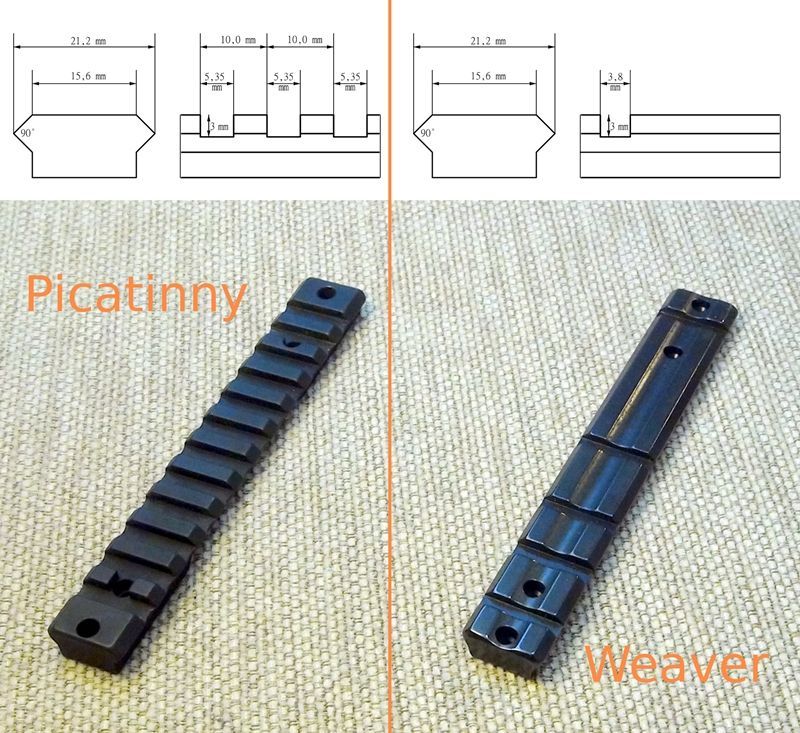
Picatinny/Weaver Rail

Picatinny Rail and Weaver rail profile

Design

The Picatinny rail is almost exclusively crafted from a single piece of metal (in some cases aluminum). In this manner, the axis of the Picatinny rail is perfectly straight and aligned with the axis of the firearm. Therefore the rifle scope which is mounted onto this kind of configuration is certainly aligned with the rifle / gun and the trajectory of the ammunition.

Weaver rail design on the other hand is usually manufactured in two separate pieces, greatly increasing the possibilities for the axis to be crooked, overlapping, and out of line.

It is always harder to align two separate pieces to a third line than it is to align one piece to another. In this way, the lapping of two mounting rings on a single-piece Picatinny rail is no longer required.

The single-piece rail will assure that both rings are perfectly aligned to each other and that no unwished stress is transferred to the riflescope.  

Picatinny compare to Weaver Rail

The Picatinny rail itself is an evolutionary step forward from the older Weaver rail. The main difference between Picatinny rail and Weaver rail is the spacing of the slots. Picatinny rail design has them evenly placed exactly 5.23 mm from one slot to the other, 3 mm deep. For this reason, the mounting options are repeatable and the same as other firearms using the Picatinny rail standard.

Interchangeability was a major driving force in the development of the new standard as different NATO armies need to be compatible with each other.

Weaver rail has 3.8mm wide slots and these slots can be placed anywhere on the Weaver rail and in any number that the producer wished.

Advantages of Picatinny design

A big advantage for using the Picatinny rail design is the ever-present recoil stop. Furthermore, the manufacturing of the rail is not very technically demanding and can be done without the use of state-of-the-art machines which greatly reduces the cost of the finished product, making it very affordable.

The Picatinny rail is easy to mount and usually, this type of configuration does not transfer negative stresses and forces from the fired weapon to the rifle scope.

In addition, the Picatinny rail with its very long useable surface works well for mounting longer rifle scopes or to achieve optimum eye relief.

The durability and toughness are other big pluses for this solution.

Manufacturers of Popular Models

A majority of the Picatinny rings are fixed, but a number of best rated European manufacturers (EAW, MAK,..) have, in recent years, put a lot of effort into the development of detachable ring with100% repeatability, with which it becomes easy to remove the scope from the weapon without the use of tools.

No re-zeroing is needed with such mount options, but these models tend to be expensive. 

Weaver and Picatinny Rings

Picatinny rail and weaver rail share one more thing. It is possible to use the Weaver ring and the Picatinny ring on the Picatinny-rails, but it is usually impossible to use the Picatinny ring on the Weaver base. The reason being the above-mentioned positioning and spacing of the slots.

  • Picatinny mounts have a 5mm recoil stop that goes into the rail slot and since
  • Weaver rail only has 3.8mm wide slots such rings do not fit on Weaver rails.

Due to this reason, the Picatinny-rails are popular and prevailing on the market in recent years and eventually, these options will completely oust the Weaver rail from the market.