Close

SAN Swiss Arms SHR 970

The History of SIG Sauer

Founded in 1853 by Heinrich Moser, Johann Conrad Neher, and Friedrich Peyer im Hof, the SIG company started as Schweizerische Waggon Fabrik. After making the Prelaz-Burnand rifle and then the M1863, they got a big order from the Swiss military and changed their name to Schweizerische Industriegesellschaft, or SIG for short. Not long after this they introduced the Mondragon, an early type of auto-loading rifle used in the Mexican Revolution and both World Wars. In 1937, they developed the P210 pistol, which quickly became known for its superior accuracy.

A few years later, SIG made some important changes that would later shape the company’s future. They started using new machines to improve the end quality of their products. With the new P220 handgun and buying companies like J.P. Sauer and Sohn and Hammerli, they became known as SIG Sauer. Over time, their guns like the P226 and P228 became popular with police and military around the world. In fact, about one out of every three US police officers chose to use SIG weapons. To reach more customers, they set up a new company in the US in 1985 and moved it to New Hampshire in 1990.

Entering the 21st century, the brand underwent further transformations. They sold their gun-making part to a company called L&O Holding in 2000 and in 2007, they started making a new line of AR-15-styled firearms like the SIGM400 and changed their name to SIG Sauer, Inc. Additionally, the company started selling other gear and shooting equipment like silencers, pellet guns, and special glasses for shooting with an important U.S. military contract awarded for the P320 in 2017. However, despite such milestones, including the establishment of the SIG Air division and the renaming of Swiss Arms as SIG Sauer AG, the company faced challenges.

They confronted legal action for export law violations and announced the shutdown of the Eckernförde factory in 2020. More recently, in 2023, the P-320 handgun faced scrutiny due to unintentional discharge issues. Despite that, according to the company's officials, SIG Sauer, Inc. remains in business and continues its operations as usual.

SAN Swiss Arms SHR 970 Rifle Review

The SAN Swiss Arms SHR 970 is a bolt action rifle that was first introduced in 1998. The rifle was manufactured by Swiss Arms and SIG Sauer under the same SHR 970 name. After selling its firearms division to the Lüke & Ortmeier Group in 2000, SIG Sauer rebranded the division as SAN Swiss Arms AG. SIG Sauer AG replaced SAN Swiss Arms AG in 2019.

With the exception of slight variations in stock materials, finish and receiver hole spacings, the rifles are nearly identical. The A and C distances of the scope mounts for the SIG SHR 970 and the SAN Swiss Arms SHR 970 differ, therefore even with these minor differences, they cannot be used interchangeably.

If you are looking for scope mount for your SIG SHR 970, you can find them here:

The rifle comes with a 559 mm (22-inch) hammer-forged free-floating barrel. The bottom of the front action ring is slotted, and the barrel is kept in the action by two Allen-headed cross bolts. The rifle's bolt body locks into the action using three equally spaced lugs. For removing the bolt, there's a button on the left rear of the action. A detachable steel magazine can hold up to four rounds and can be released by a button within its aluminum-alloy trigger guard. It is covered by a steel floorplate.

On the upper end of receiver there are drilled and tapped holes for scope mounting. On its right side, the rifle's receiver features a safety lever with "S" and "F" markings. The safety comes in the form of a three-position lever which is placed on the right rear side of the receiver.

The "S" position at the back keeps the rifle in "SAFE" mode, locks the bolt, and blocks the sear to stop it from shooting. A white dot designates the center position, which blocks the sear but allows the bolt to be opened for loading or unloading. The gun and bolt can be fired when in the forwardmost "F" position. The SHR 970's design offers rapid barrel change. Additionally, the rifle features factory-preset trigger weight of about 2041 g and interchangeable barrels. The rifle includes a thin rubber buttpad at the rear of the stock, and two QD sling swivel studs are already in place.

Swiss Arms SHR 970 rifle, chambered for .308 Win.

Figure 1: Swiss Arms SHR 970 rifle, chambered for .308 Win. (Source: https://laststandonzombieisland.com/tag/shr-970/)

SAN Swiss Arms SHR 970 Calibers

The rifle can be chambered for the following calibers:

  • .25-05 Rem.

  • .270 Win.

  • .280 Rem.

  • .308 Win.

  • .30-06 Spr.

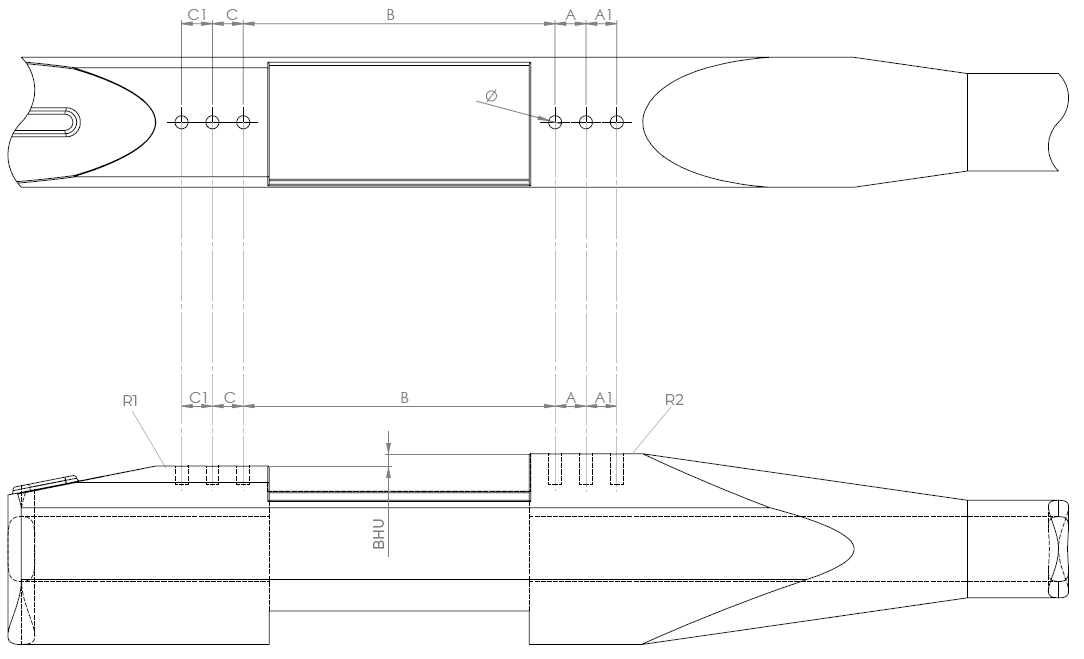
Please note that the Swiss Arms SHR 970 model features six mounting holes atop its receiver—three at the front and three at the rear, with the primary outer distance measuring 21.9 mm. This is different from the SIG SHR 970 models, which have only four holes, spaced 12.7 mm apart. The majority of scope mounts suitable for Swiss Arms SHR 970 come with four holes though, with the front and rear (A & C) holes spacings measuring equidistant 21.9 mm, and the inner B spread measuring 93.4 mm.

The scope mounts are thus not interchangeable between SIG SHR 970 and SAN Swiss Arms SHR 970, as the A and C distances are different. You can find scope mounts for SIG SHR 970 here.

The receiver of SAN Swiss Arms SHR 970, chambered for .308 Win.

Figure 2: The receiver of SAN Swiss Arms SHR 970, chambered for .308 Win. (Source: https://www.gunboards.com/threads/any-other-sig-shr-970-owners-here.12135/page-4)

SAN Swiss Arms SHR 970

A: 21.9 mm

B: 93.4 mm

C: 21.9 mm

BHU: 0 mm

Ø: 6-48

R1: R17

R2: R17

Scope Mounts Interchangeable With SAN Swiss Arms SHR 970

Rifles that have One-Piece Scope Mounts Interchangeable With SAN Swiss Arms SHR 970

For one-piece mounts to fit on a rifle, mounting surfaces on these rifles must match in every dimension.

Currently, we cannot find any rifles that would match the exact B distance of the SAN Swiss Arms SHR 970 mounting surface; thus we are unable to provide you with a list interchangeable one-piece scope mounts.

Rifles That Have Two-Piece Scope Mounts Interchangeable With SAN Swiss Arms SHR 970

To meet interchangeability conditions, two-piece mounts must match in all dimensions except the B distance. B distance can vary because two-piece mounts can be installed and adjusted closer or further apart. Rifles that have two-piece scope mounts interchangeable with SAN Swiss Arms SHR 970 are the following:

Best Scope Mounts for SAN Swiss Arms SHR 970

Fixed Scope Mounts for SAN Swiss Arms SHR 970

If you are looking for a fixed mounting solution to add to your rifle, this two-piece steel rings with bases made by the German company MAKfix will suit your needs as they fit perfectly on SAN Swiss Arms SHR 970. They are recoil resistant and come with a thirty-year warranty.

Detachable Repeatable Scope Mounts for SAN Swiss Arms SHR 970

If you are looking for a detachable scope mount to fit on your SAN Swiss Arms SHR 970, we recommend this two-piece pivot mount manufactured by the German company EAW. It is made of high-quality steel and comes with a thirty-year warranty.

Picatinny Rails for SAN Swiss Arms SHR 970

Picatinny rails are one of the best mounting solutions when it comes to variability. They have equidistant slots all over the surface allowing the device to be mounted wherever the user finds it fitting. This durable Picatinny rail manufactured by the German company EAW is made of high-quality steel and is an ideal fit for your SAN Swiss Arms SHR 970 rifle. Additionally, it comes with a 30-year warranty for added peace of mind.

Help Us Build Our Riflescope Mounts Database

If you happen to own this or any other rifle, we would appreciate it if you could help us expand our database by sending us some photos of the rifle receiver (the bare mounting surface of the rifle without the scope mounts installed). For your help, our company offers a fair return in terms of practical rewards.

Please send us an email for more information. You can contact us here: info@optics-trade.eu

Filters
Sort
4 Items
Show
per page
Close
Sort By
  1. In stock
  2. Out of stock
  1. Cheapest in stock
In stock
NOK 1,061.32
In stock
As low as NOK 3,454.70
In stock
As low as NOK 725.59
In stock
NOK 1,061.32
Filters
Sort
4 Items
Show
per page
Close
Sort By

VIDEO

Introduction

In recent years we can observe that a trend of Picatinny rail has become widespread and global. It is driven by the NATO standardized rails, more commonly known as the Picatinny rail standard. Picatinny rail being the New Jersey Arsenal that developed it in 1995.

These mounting options are revolutionary. The biggest and best advantage being that the Picatinny rail can be used its entire length and not bordered to a few pre-designed slots like for example the Weaver rail standard was before.

The other main advantage is the ease of use and interchangeability. If a product is meant for a Picatinny rail design it will fit all Picatinny-rails, no matter the manufacturer or date of production.

Picatinny/Weaver Rail

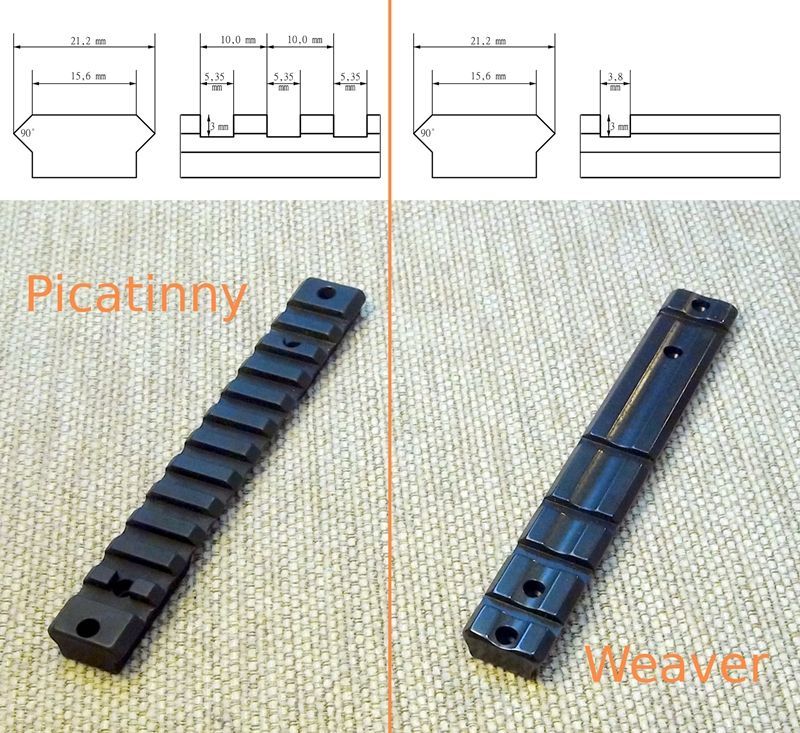
Picatinny Rail and Weaver rail profile

Design

The Picatinny rail is almost exclusively crafted from a single piece of metal (in some cases aluminum). In this manner, the axis of the Picatinny rail is perfectly straight and aligned with the axis of the firearm. Therefore the rifle scope which is mounted onto this kind of configuration is certainly aligned with the rifle / gun and the trajectory of the ammunition.

Weaver rail design on the other hand is usually manufactured in two separate pieces, greatly increasing the possibilities for the axis to be crooked, overlapping, and out of line.

It is always harder to align two separate pieces to a third line than it is to align one piece to another. In this way, the lapping of two mounting rings on a single-piece Picatinny rail is no longer required.

The single-piece rail will assure that both rings are perfectly aligned to each other and that no unwished stress is transferred to the riflescope.  

Picatinny compare to Weaver Rail

The Picatinny rail itself is an evolutionary step forward from the older Weaver rail. The main difference between Picatinny rail and Weaver rail is the spacing of the slots. Picatinny rail design has them evenly placed exactly 5.23 mm from one slot to the other, 3 mm deep. For this reason, the mounting options are repeatable and the same as other firearms using the Picatinny rail standard.

Interchangeability was a major driving force in the development of the new standard as different NATO armies need to be compatible with each other.

Weaver rail has 3.8mm wide slots and these slots can be placed anywhere on the Weaver rail and in any number that the producer wished.

Advantages of Picatinny design

A big advantage for using the Picatinny rail design is the ever-present recoil stop. Furthermore, the manufacturing of the rail is not very technically demanding and can be done without the use of state-of-the-art machines which greatly reduces the cost of the finished product, making it very affordable.

The Picatinny rail is easy to mount and usually, this type of configuration does not transfer negative stresses and forces from the fired weapon to the rifle scope.

In addition, the Picatinny rail with its very long useable surface works well for mounting longer rifle scopes or to achieve optimum eye relief.

The durability and toughness are other big pluses for this solution.

Manufacturers of Popular Models

A majority of the Picatinny rings are fixed, but a number of best rated European manufacturers (EAW, MAK,..) have, in recent years, put a lot of effort into the development of detachable ring with100% repeatability, with which it becomes easy to remove the scope from the weapon without the use of tools.

No re-zeroing is needed with such mount options, but these models tend to be expensive. 

Weaver and Picatinny Rings

Picatinny rail and weaver rail share one more thing. It is possible to use the Weaver ring and the Picatinny ring on the Picatinny-rails, but it is usually impossible to use the Picatinny ring on the Weaver base. The reason being the above-mentioned positioning and spacing of the slots.

  • Picatinny mounts have a 5mm recoil stop that goes into the rail slot and since
  • Weaver rail only has 3.8mm wide slots such rings do not fit on Weaver rails.

Due to this reason, the Picatinny-rails are popular and prevailing on the market in recent years and eventually, these options will completely oust the Weaver rail from the market.