Close

30mm Scope Mount Rings

VIDEO

General features

There is more than one way to mount a rifle scope, but the most widespread is the option with rings. It has numerous advantages, for starters, it's affordable and available in the biggest number of versions. A lot of today's riflescopes need a 30mm scope mount - because they feature a 30mm main tube diameter. This means that in order for you to connect your rifle scope to the firearm you need the 30 mm rings for mounting. The most important thing when mounting a rifle scope with rings is to be aware of the appropriate force needed to fasten the rings. Go over the limit and the structural integrity of the rifle scope will be compromised. Rings can also leave a visible mark if not tighten accordingly. The amount of torque should not exceed 2.2 Nm.

Since the rifle scopes with 30mm tubes are the most common one in today’s world, the range of 30mm mounts is the widest among all mounting options. Even on our webpage, this category of mounts is the biggest. There is almost no firearm in existence that would not have at least some sort of mounts for 30mm scopes.

Rings for the 30mm scope tubes on hunting rifles are usually 15mm wide and thus slick and elegant. Tactical mounts are however in most cases much wider (up to 32mm) and thus more robust and bigger. With very wide rings the pressure on the scope tube is better to disperse and a better and more secure fit is achieved. Wide tactical rings also leave fewer marks on the scope tube. On the other hand, bulky tactical rings don’t really look appropriate on elegant hunting rifles.

While many mounts meant for hunting rifles are still made from steel, almost all tactical mounts are made from aluminum. High-quality European riflescope mount producers use high-quality aluminum alloys which are equally strong as steel but much light at the same time.

Hunting mounts with 30mm rings usually have 1/3 – 2/3 arrangement of the rings and tactical mounts usually have ½ - ½ arrangement. 

Hawke 9-11mm Match Mounts, 30mm, 0 MOA, Matte style

Hawke 9-11mm Match Mounts, 30mm scope mount

The 30 mm rings are manufactured by: 

Is lapping of the rings really needed?

Lapping is a process that is essentially lining two mounting rings perfectly to one-a-another. It is done with special cylinders that grind off the excess metal.

When the ring is constructed from two near half circles - so if the circle of the ring is split in half, roughly in the ratio 50:50 and such rings are mounted on two separate mounting bases, then lapping is recommended. If lapping is not performed, the very small offsetting can be present when all the different pieces of the mount come together and when both rings are mounted on two separated bases. If the mounting of two high-quality rings is done on a single-piece base, then lapping is not needed. This is one of the reasons that Picatinny rails style are becoming so popular in recent years.

In the worst-case scenario, the axis that runs through the center of the rear ring does not completely match the axis that runs through the center of the front ring. For this reason, the scope, if mounted into such rings is under unwanted structural stress. The most obvious problems that occur due to this reason are less than perfect optical performance, tracking problems, the side focus mechanism can stop working and the point of impact groups can be dispersed.

If the ring is designed in the fashion of 1/3 base of the ring and 2/3 of the top of the ring then lapping is not required as the design is plastic enough to bend slightly and adjust its shape to the scope tube. The same applies to ½-1/2 rings mounted on the single-piece base.

It may be a good idea to take into consideration to choose the 1/3: 2/3 rings as they do not require additional lapping to be fitted properly. Or use a single-piece mounting base.

Lapping is also not required with monoblock mounts and all mounts are made from one piece of material and alignment of both rings is usually perfect. It is also not required with high-quality European mounts since their tolerances are minimal.

Filters
Sort
1 Item
Show
per page
Close
Sort By
In stock
As low as $369.00
Filters
Sort
1 Item
Show
per page
Close
Sort By

VIDEO

Introduction

In recent years we can observe that a trend of Picatinny rail has become widespread and global. It is driven by the NATO standardized rails, more commonly known as the Picatinny rail standard. Picatinny rail being the New Jersey Arsenal that developed it in 1995.

These mounting options are revolutionary. The biggest and best advantage being that the Picatinny rail can be used its entire length and not bordered to a few pre-designed slots like for example the Weaver rail standard was before.

The other main advantage is the ease of use and interchangeability. If a product is meant for a Picatinny rail design it will fit all Picatinny-rails, no matter the manufacturer or date of production.

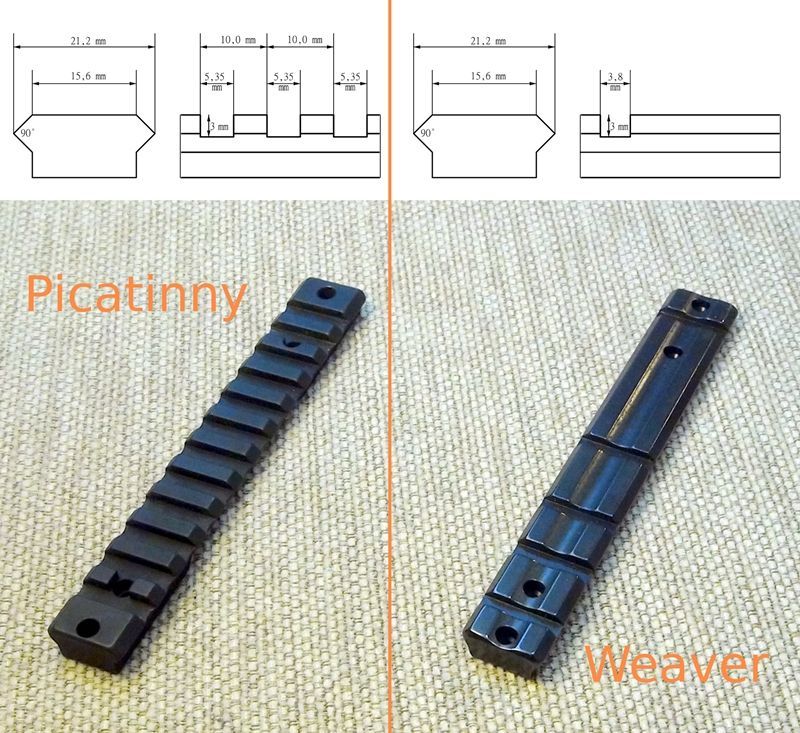
Picatinny/Weaver Rail

Picatinny Rail and Weaver rail profile

Design

The Picatinny rail is almost exclusively crafted from a single piece of metal (in some cases aluminum). In this manner, the axis of the Picatinny rail is perfectly straight and aligned with the axis of the firearm. Therefore the rifle scope which is mounted onto this kind of configuration is certainly aligned with the rifle / gun and the trajectory of the ammunition.

Weaver rail design on the other hand is usually manufactured in two separate pieces, greatly increasing the possibilities for the axis to be crooked, overlapping, and out of line.

It is always harder to align two separate pieces to a third line than it is to align one piece to another. In this way, the lapping of two mounting rings on a single-piece Picatinny rail is no longer required.

The single-piece rail will assure that both rings are perfectly aligned to each other and that no unwished stress is transferred to the riflescope.  

Picatinny compare to Weaver Rail

The Picatinny rail itself is an evolutionary step forward from the older Weaver rail. The main difference between Picatinny rail and Weaver rail is the spacing of the slots. Picatinny rail design has them evenly placed exactly 5.23 mm from one slot to the other, 3 mm deep. For this reason, the mounting options are repeatable and the same as other firearms using the Picatinny rail standard.

Interchangeability was a major driving force in the development of the new standard as different NATO armies need to be compatible with each other.

Weaver rail has 3.8mm wide slots and these slots can be placed anywhere on the Weaver rail and in any number that the producer wished.

Advantages of Picatinny design

A big advantage for using the Picatinny rail design is the ever-present recoil stop. Furthermore, the manufacturing of the rail is not very technically demanding and can be done without the use of state-of-the-art machines which greatly reduces the cost of the finished product, making it very affordable.

The Picatinny rail is easy to mount and usually, this type of configuration does not transfer negative stresses and forces from the fired weapon to the rifle scope.

In addition, the Picatinny rail with its very long useable surface works well for mounting longer rifle scopes or to achieve optimum eye relief.

The durability and toughness are other big pluses for this solution.

Manufacturers of Popular Models

A majority of the Picatinny rings are fixed, but a number of best rated European manufacturers (EAW, MAK,..) have, in recent years, put a lot of effort into the development of detachable ring with100% repeatability, with which it becomes easy to remove the scope from the weapon without the use of tools.

No re-zeroing is needed with such mount options, but these models tend to be expensive. 

Weaver and Picatinny Rings

Picatinny rail and weaver rail share one more thing. It is possible to use the Weaver ring and the Picatinny ring on the Picatinny-rails, but it is usually impossible to use the Picatinny ring on the Weaver base. The reason being the above-mentioned positioning and spacing of the slots.

  • Picatinny mounts have a 5mm recoil stop that goes into the rail slot and since
  • Weaver rail only has 3.8mm wide slots such rings do not fit on Weaver rails.

Due to this reason, the Picatinny-rails are popular and prevailing on the market in recent years and eventually, these options will completely oust the Weaver rail from the market.